

As he came to undertake jury duty, Paul Powlesland realised that the usual non-religious affirmation didn't mean much to him. So he asked the judge if he could do something a little different – swear an oath on the River Roding, which is the third biggest river in London. Paul has been living by the Roding on a boat for seven years, surrounded by the wildlife, and feels a deep connection to it. He works to restore the habitat and protect the river through removing rubbish, planting trees and campaigning, as part of the River Roding Trust. Paul is both living and acting in a way that treats nature as sacred while campaigning for social and legal change which also respects this.
The oath Paul swore was:
“I swear by the River Roding, from her source in Molehill Green to her confluence with the Thames, that I will faithfully try the defendant and give a true verdict according to the evidence.”
In Paul's words, it was "a somewhat mad-cap week for animism and the sacredness of Nature in the English courts". Reflecting on the news coverage that it received, he said:
"I was genuinely surprised by the amount of interest in the oath, which seems to have captured a lot of people’s imaginations. I think it shows that support for the idea of Nature as alive is greater than we might realise and more people believe in the sacredness of Nature than we might think. It was lovely to receive messages from people who were inspired by the oath to do something similar. Here’s hoping it just the first of many similar interventions for Nature and the Earth in the legal system."

The oath was commented on in an amused observation from the judge in the case. After the jury delivered a verdict in our case, His Honour Judge Falk said in a wry tone: “You tried this case faithfully according to the evidence, as you took an oath to do... whether on a river or otherwise.”
Though this is not a typical oath, the legal consensus seems to be that the oath itself was valid under the Oaths Act 1978. However, to avoid having detailed legal argument to decide this, it was agreed that Paul would additionally give the standard affirmation as a 'belt and braces' approach.
Further coverage can be found here:
My local river is so dear to me that I swore my juror oath on it
.svg)
Environmentalist becomes first juror to swear oath on river water
Juror swears oath on a river in legal first
I swear by almighty river: an ancient practice is making a comeback in Britain’s courts | Tim Adams
Share


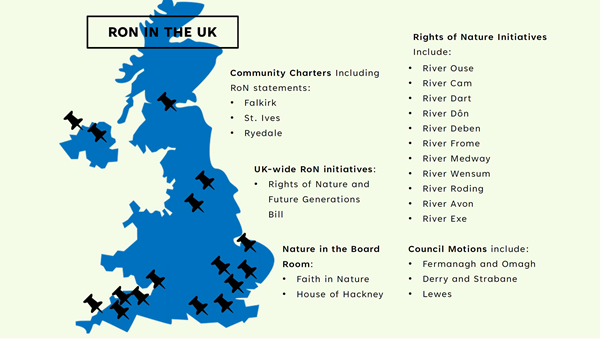
The Rights of Nature (RoN) movement in the UK has been newly revitalised over recent years. There was an early flurry of activity around 2005-2010, clustered around the UK Environmental Law Association (UKELA), which included some conferences, an excellent research report analysing the extent to which Wild Law already existed around the world, and annual Wild Law weekends (which continue!).

Magazine articles and blogs, conference videos and podcasts, books and films: we are awash with information and ideas, making it hard for any, however good, to break through. Occasionally, one does and, happily, that appears to be the case with Giving Nature a Seat on the Board.

In April 2022, the Irish Citizens’ Assembly on Biodiversity Loss (“The Assembly”) held its inaugural meeting in Dublin Castle. Since then, the Assembly, which is made up of 99 randomly-selected members of the public and an independent Chairperson, has been examining how the state can improve its response to biodiversity loss. On completion of its work later this year, the Assembly will make a number of recommendations to the Government in this regard.