At Lawyers for Nature, we work to reimagine the law for Nature. We advocate for the recognition of Nature as a subject of law rather than an object, giving Nature a voice and a vote in the decisions that shape its future. We have done this through Nature on the Board, embedding Nature's voice into the governance of organisations, companies, community interest companies and public bodies.
This article is about where we are taking that work next: Towards a Parliament of Rivers.
The UK's rivers are in crisis. That much is now widely accepted, and the sewage debate of the past few years has put it firmly in public view.
What is less often said is that rivers have no voice at all in the decisions that determine their condition. Those decisions are made in rooms full of professionals, such as regulators, water companies, planners, consultants, all speaking a technical language, in working hours, to each other. It is a serious conversation conducted by serious people, and the river itself is absent from it, as, for the most part, are the public and the guardians who know these rivers best.
Yet across the country there are people who know a particular river with a depth of knowledge that no consultation exercise will ever capture. They have walked its length, they know where the outfalls are, which ones run when it rains, which stretch silts up, where the fish were and are not now. They monitor, they gather data, they intervene when official institutions do not. And they have no standing whatsoever. Their knowledge is not sought, their evidence is not weighed, and there is no route by which what they know reaches the people who decide.
This is the imbalance we want to correct.
Our co-founder Paul Powlesland has lived on a boat on the River Roding for the past ten years. In 2019 he founded the River Roding Trust, where he works as a volunteer guardian of the river. The role of a river guardian is one of active love, care, connection, practical work and campaigning to protect and restore a river, to uphold its rights, and to speak and act in its interests.
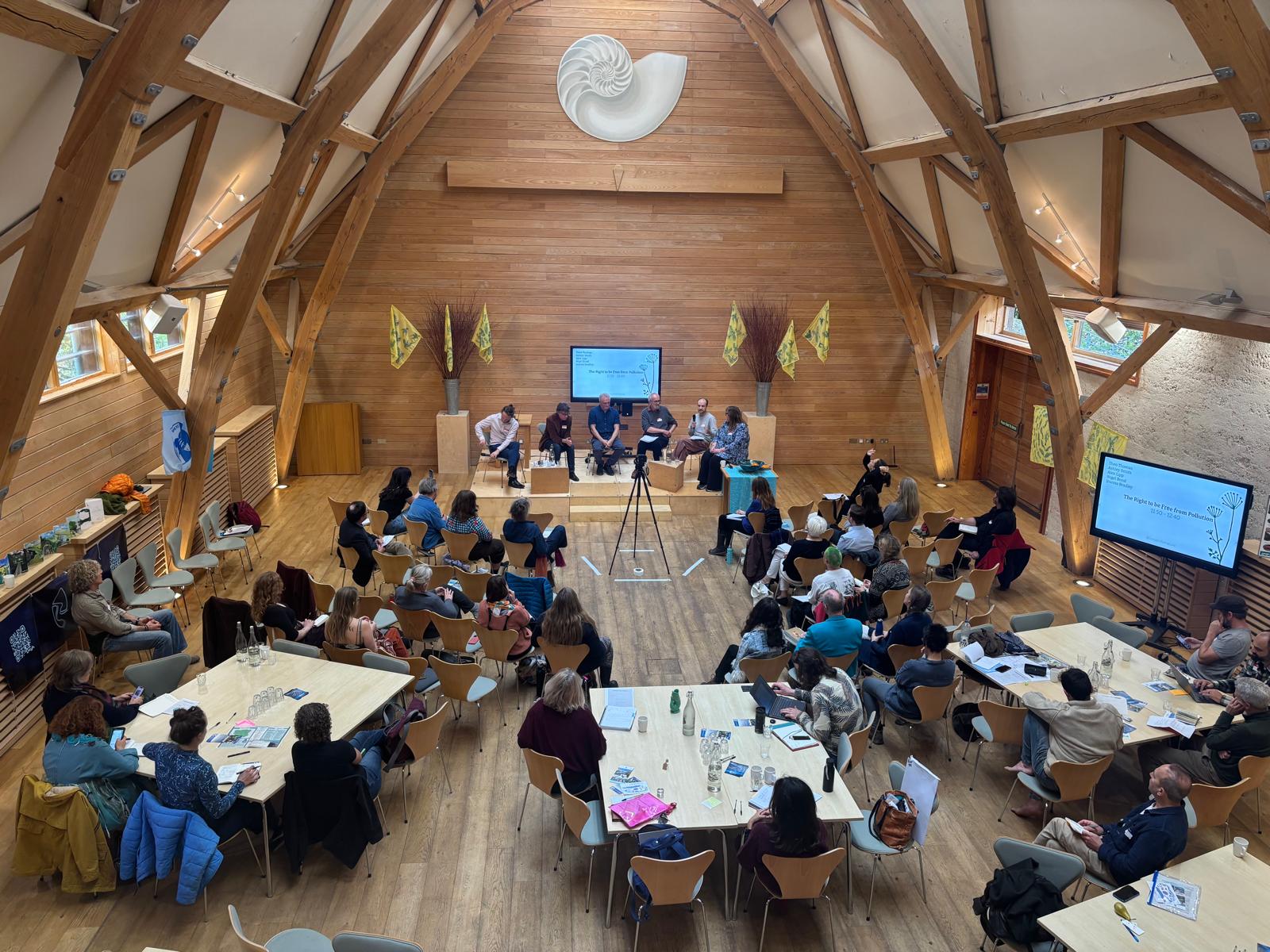
In October 2025 we hosted the River Guardians Summit, which brought together more than fifty people representing over twenty rivers. It was an inspiring weekend that has stayed with us ever since. What struck us most was how much there was to learn from each other, practical solutions to particular pollution sources, strategic litigation, and the everyday wisdom that comes from knowing a river intimately over years. All of it held by individuals, in separate places, with no means of adding up.
We came away asking how we take what these people know and put it in front of those with the power to act on it.
.jpg)
The Rights of Rivers movement is growing strongly in the UK, with several local groups adopting River Charters. In February 2025 the River Ouse became the first UK river to have its rights recognised by a local authority, when Lewes District Council adopted a decision to support the principles in its Rights of Rivers Charter. Several other local authorities across the UK have since passed their own rights of rivers motions.
Most existing UK Rights of Rivers declarations are based on the Universal Declaration of River Rights, which sets out moral rights such as the Right to Flow, the Right to be Free from Pollution, the Right to Native Biodiversity, and the Right to Restoration. As universal moral principles, these are powerful and we wholeheartedly support them. As a legal mechanism for protecting rivers in an industrialised, densely populated country like the UK, they alone cannot solve the multiple problems our rivers face.
Take the example of the Right to Flow. In its natural state, a river flowing through untouched forest has a clear right to flow without artificial impediment. But there are over 70,000 barriers, weirs, dams and impoundments on UK rivers. Some are completely pointless and could be removed tomorrow at little cost and no risk to human interests. Some are vital flood defences protecting human lives and homes. Most fall somewhere in between, with leisure, historical, or amenity value attached. A general "Right to Flow," expressed in abstract terms, gives no guidance on how to differentiate between them, no pathway towards actually removing the obstructions that should be removed, and no protection for those that should remain.
The same issue applies to the Right to be Free from Pollution. There are many sources of river pollution in the UK, such as sewage, agricultural run-off, road run-off, rubbish, chemical pollution, and others. Some of these need different solutions, different timeframes and prioritisation, and very different levels of public expenditure. A general right, valuable as it may be, in principle does not tell us how all of this should be navigated. The Right to Restoration tells us a river should be restored, but cannot tell us how to balance restoration against the fact that we cannot demolish half of central London to return the Thames to its natural estuarine width.
A right expressed in very general terms can also be difficult for courts to enforce and for government to implement, and that limits what it can deliver for the river itself. The challenge is to ensure that the rights we advocate for can be meaningfully upheld and translated into policy.
In March 2026 the House of Commons Library published a research briefing titled Rights of Rivers (CBP-10496), setting out international case studies and recent local authority motions. The briefing notes that Parliamentary discussion so far has been limited, with related debates also taking place in the Senedd Cymru and the Scottish Parliament, but that the Liberal Democrat MP Roz Savage has raised the idea of legal personhood and river representation in a Commons debate on water company regulation.
.png)
Those local authority motions are where the momentum is being built. This year alone we have already worked with Maidstone Borough Council, which recently adopted a Rights of Nature framework, and with the River Wye. Rights of Nature is now taking root across local government.
The fact that the Commons Library is briefing MPs on rights of rivers tells us the idea is no longer on the fringes. It is becoming a question Parliament will eventually have to answer.
Our work is to give rivers a voice through the people who live with them, care for them and understand them, and to make sure that voice reaches those with the power to act.
Building towards a Parliament of Rivers starts with conversation. From October we will hold regular calls for river guardians to discuss what is happening on your river, what you have tried, what worked and what did not. Sewage, road run-off, obstructions, abstraction, development pressure, the loss of native species. The same problems recur on river after river, and we want to put these accounts side by side to form a national picture. Over the course of the year those conversations will build into a policy paper, written out of what guardians actually know, to put in front of parliamentarians and policymakers.
Alongside that we want to get out onto the rivers themselves. Some of the ideas we are exploring are river walks, river hearings and local debates. We are also open to suggestions of what you would want to see happening along your river to bring communities together.
Everything this produces, the accounts, the maps, the case studies and the testimony, is the raw material of policy. Beyond the paper we will keep putting river-centred positions to government, agencies and regulators, and create the moments and events that carry them there.
In time, the Parliament of Rivers will look and feel like a national gathering of people who speak for their rivers, with evidence behind them and a route to the decisions that matter.
If you know a river, love it, and are already active in caring for it, we would like you to join us. If you work in policy connected to rivers, we would love to hear from you.
We are holding regular calls for river guardians from October. From those conversations we will build the evidence and the policy asks, and create the events that carry them to the people who make decisions.
Express your interest in joining, either as a river guardian or someone who works in policy, here.
If you would like to support our work at Lawyers for Nature more broadly, please consider donating.
.svg)
Share