

So far, the Green Party is the only party with Rights of Nature laws mentioned in their party manifesto. Our hope is that political candidates from other parties might also begin to support the idea that there is a need to change our whole legal system to restore and benefit Nature. Stopping the destruction of the natural world is vitally important, yet current proposals do not go far enough. Last weekend, on Saturday 22nd June, over 60,000 people marched in London to demand: Restore Nature Now.
If you would like to raise the idea of Rights of Nature with a political candidate, here are some questions you could ask at your local hustings, on social media, and in correspondence with them.
We call on all Nature defenders to start asking these important questions at political events in the run up to the election.
1. What is ‘Rights of Nature’?
Currently, our legal system is only for humans and human organisations, and it functions primarily to benefit humans – and causes significant harm to non-humans and ecosystems while doing so.
Rights of Nature is the idea that various elements of nature should have legal rights – such as the right to ecological integrity, to maintain life cycles, to be free from pollution, and to restoration from damage – and the ability to act (via human representatives) in the legal system, known as legal personhood.
Our legal system must protect and benefit non-humans and vital ecosystems – both for its own sake and because we need to ensure a healthy environment for humans to live in.
2. Why don’t we just strengthen environmental law?
Rights of Nature takes a fundamentally different approach to environmental law:
1. Do you agree that we need Rights of Nature legislation to ensure that nature is properly protected?
We think that wholesale legal reform is necessary to reverse the current trends of ecological destruction, and that Rights of Nature is currently the best proposed model for this.
2. Do you agree that we need a radically different paradigm to environmental protection than we currently have? And that we should place ecological health and sustainability at the core of our legal and economic system?
This question focuses on the fact that existing approaches have failed, and that we need a radically different approach. So where a candidate may not want to comment much on the concept of ‘Rights of Nature’ that they might not know much about, this focuses on the issue itself.
3. [With reference to a local campaign] – do you agree with campaigners that we should give the River _____ legal rights so that it can defend itself in our legal system and be protected to good ecological health?
If there is a local conservation campaign in your area which is taking a Rights of Nature approach, then you can ask a question about whether the candidates think of a Rights of Nature approach in relation to that.
.svg)
Share


.png)
Today we are pleased to publish a new report titled “Realising Rights of Nature: Conceptual Foundations for Legislation” by Alex May. This new report seeks to map out the breadth and depth of what Rights of Nature legislation could cover, including the different elements which a legislative framework would need, the different dimensions of rights and subjecthood, the different legal effects and areas of law which could be included, alongside some possible legislative models. Much of this is relevant for anyone thinking about how best to implant Rights of Nature.
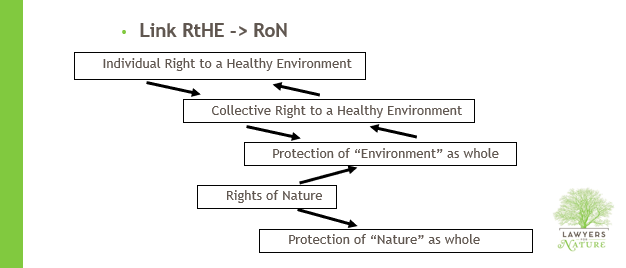
Last month, we submitted a response to the Scottish Government’s consultation on ‘A Human Rights Bill for Scotland' to emphasise the importance of taking an ecological approach to the Right to a Healthy Environment, and to highlight the role that Rights of Nature can have in realising this.

Today a new Nature’s Rights Bill was launched at the House of Lords by the Green party peer Natalie Bennett. For decades, lawyers, campaigners, and communities have worked to bring the idea of rights for Nature and legal personhood for Nature into the public imagination.